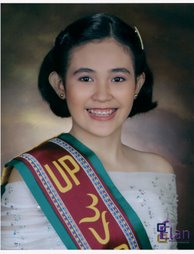
Mikaela Irene Fudolig – BS Physics
Speech at the 96th General Commencement Exercises,
University of the Philippines, Diliman
April 22, 2007
(Click here to hear my speech.)One of the things that strike me as being very “UP Diliman” is the way UPD students can’t seem to stay on the pavement. From every street corner that bounds an unpaved piece of land, one will espy a narrow trail that cuts the corner, or leads from it. Every lawn around the buildings sports at least one of these paths, starting from a point nearest to the IKOT stop and ending at the nearest entry to the building. The trails are beaten on the grass by many pairs of feet wanting to save a fraction of a meter of traveling, no matter that doing so will exact some cost to the shoes, or, to the ubiquitous slippers, especially when the trails are new.
What do these paths say about us, UP students?
One could say that the UP student is enamored with Mathematics and Pythagoras, hence these triangles formed by the pavement and the path. Many among you would disagree.
Others could say that the UP student is naturally countercultural. And the refusal to use the pavement is just one of the myriads of ways to show his defiance of the order of things. This time, many would agree.
Still, others will say that the UP student is the model of today’s youth: they want everything easier, faster, now. The walkable paths appeal to them because they get to their destination faster, and presumably, with less effort. Now that is only partly true, and totally unfair.
These trails weren’t always walkable. No doubt they started as patches of grass, perhaps overgrown. Those who first walked them must have soiled their shoes, stubbed their toes, or had insects biting their legs, all in the immovable belief that the nearest distance between two points is a straight line. They might even have seen snakes cross their paths. But the soiled footwear, sore toes, and itchy legs started to conquer the grass. Other people, seeing the yet faint trail, followed. And as more and more walked the path, the grass gave in and stopped growing altogether, making the path more and more visible, more and more walkable.
The persistence of the paths pays tribute to those UP students who walked them first – the pioneers of the unbeaten tracks: the defiant and curious few who refuse the familiar and comfortable; the out-of-the-box thinkers who solve problems instead of fretting about them; the brave who dare do things differently, and open new opportunities to those who follow.
They say how one behaved in the past would determine how he behaves in the future. And as we leave the University, temporarily or for good, let us call on the pioneering, defiant, and brave spirit that built the paths to guide us in this next phase of our life.
We have been warned time and again. Our new world that they call “adulthood” is one that’s full of compromises, where success is determined more by the ability to belong than by the ability to think, where it is much easier to do as everyone else does. Daily we are bombarded with so much news of despair about the state of our nation, and the apparent, perverse sense of satisfaction our politicians get from vilifying our state of affairs. It is fashionable to migrate to other countries to work in deceptively high-paying jobs like nursing and teaching, forgetting that even at their favored work destinations, nurses and teachers are some of the lowest paid professionals. The lure of high and immediate monetary benefits in some low-end outsourcing jobs has drawn even some of the brightest UP students away from both industry and university teaching to which they would have been better suited.
Like the sidewalks and pavement, these paths are the easiest to take.
But, like the sidewalks and pavement, these paths take longer to traverse, just as individual successes do not always make for national progress. The unceasing critic could get elected, but not get the job done. The immigrant could get his visa, but disappear from our brainpower pool. The highly paid employee would be underutilized for his skills, and pine to get the job he truly wants, but is now out of his reach. And the country, and we, are poorer because of these.
Today, the nation needs brave, defiant pioneers to reverse our nation’s slide to despair. Today, we must call upon the spirit that beat the tracks. Today, we must present an alternative way of doing things.
Do NOT just take courage, for courage is not enough. Instead, be BRAVE! It will take bravery to go against popular wisdom, against the clichéd expectations of family and friends. It will take bravery to gamble your future by staying in the country and try to make a prosperous life here. It might help if for a start, we try to see why our Korean friends are flocking to our country. Why, as many of us line up for immigrant visas in various embassies, they get themselves naturalized and settle here. Do they know something we don’t?
Do NOT just be strong in your convictions, for strength is not enough. Instead, DEFY the pressure to lead a comfortable, but middling life. Let us lead this country from the despair of mediocrity. Let us not seek to do well, but strive to EXCEL in everything that we do. This, so others will see us as a nation of brains of the highest quality, not just of brawn that could be had for cheap.
Take NOT the road less traveled. Rather, MAKE new roads, BLAZE new trails, FIND new routes to your dreams. Unlike the track-beaters in campus who see where they’re going, we may not know how far we can go. But if we are brave, defiant searchers of excellence, we will go far. Explore possibilities, that others may get a similar chance. I have tried it myself. And I’m speaking to you now.
But talk is cheap, they say. And so I put my money where my mouth is. Today, I place myself in the service of the University, if it will have me. I would like to teach, to share knowledge, and perhaps to be an example to new UP students in thinking and striving beyond the limits of the possible. This may only be a small disturbance in the grass. But I hope you’ll come with me, and trample a new path.
Good evening, everyone.